
The Last Leaf
I created this short narrative film entirely using Runway ML as a personal case study in storytelling with generative AI. Specifically, how to create consistent characters, environments, and shot sequences in a system that doesn’t naturally preserve continuity.
Very quickly, it became clear that generating individual “good shots” isn’t the challenge. The challenge is maintaining coherence across shots and keeping a character’s proportions stable, preserving environment layout, and ensuring actions connect cleanly from one moment to the next.
Designing for Consistency First
The biggest shift in approach was treating the process less like shot-making and more like pre-production.
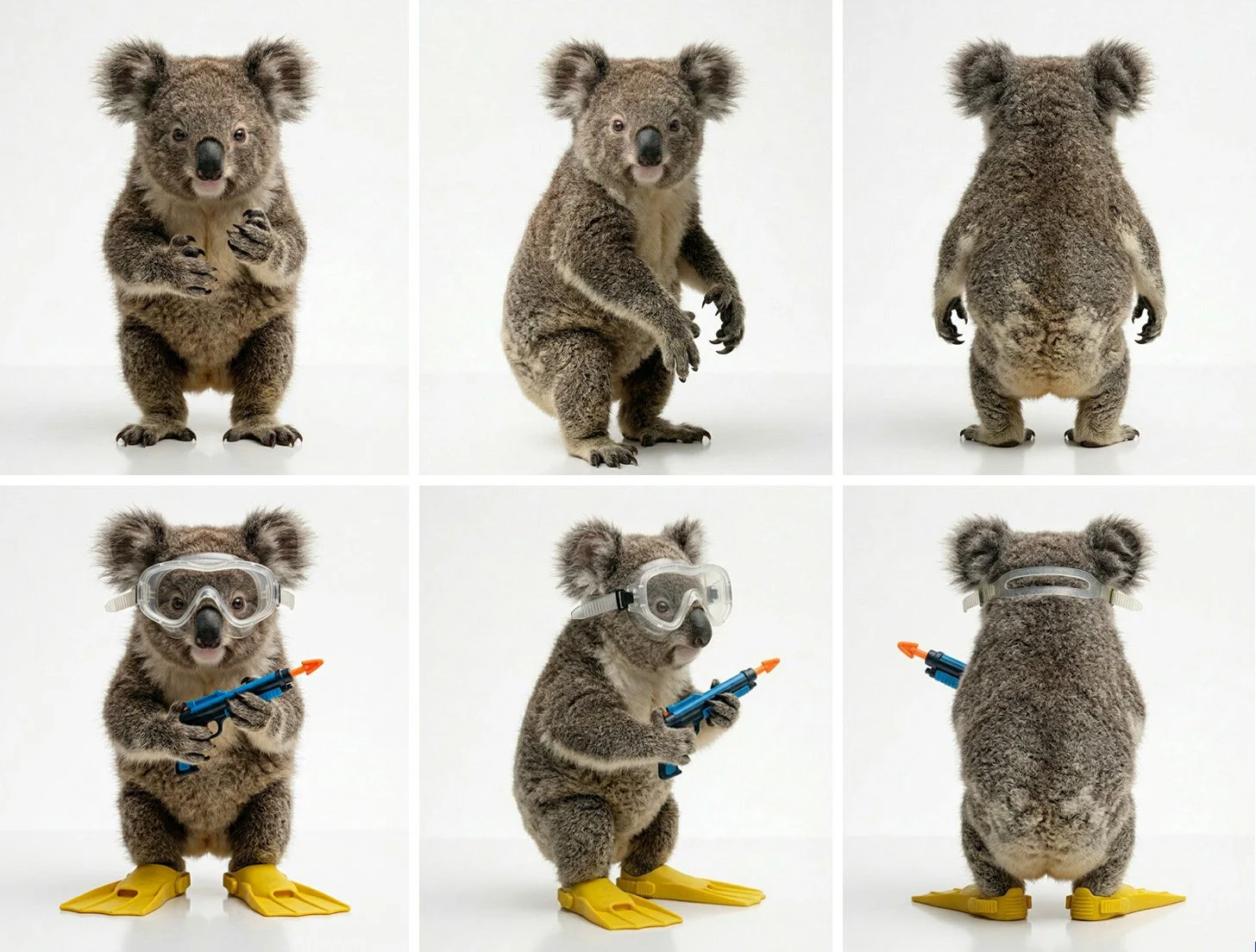
Before generating any sequences, I developed a consistent visual foundation through character and prop sheets:
A defined character (the koala) with stable proportions, with and without his gear.
A controlled environment (the island) with fixed layout and landmarks, “rendered” from all angles.
A small set of props (spear gun, crate, goggles, etc.) that could be reused across shots
By creating these elements up front, essentially building a “character sheet” and environment references, I was able to guide the model toward consistency rather than reinventing the scene every time by “tagging” my props and characters and telling the engine, whether I was using Nano Banana, Kling or Runways own Aleph to use “Character X” with “Prop Y” in “Location Z”
Without this step, every shot becomes a reinterpretation. With it, the system starts to behave more like a production pipeline.
Prompting as Direction, Not Description
Another key realization was that prompting isn’t really about describing what an image should look like. it’s about constraining change.
The most effective prompts weren’t the most detailed ones, but the ones that clearly defined:
what must stay fixed (camera, layout, character scale)
what is allowed to change (motion, pose, expression)
In practice, this meant treating each frame like a locked plate and only introducing controlled variation. Small changes, like moving a hand or shifting posture had to be explicitly isolated, otherwise the entire scene would drift.


Takeaways
This project wasn’t just about making a short film. It was about understanding how to work with generative systems instead of against them.
A few key takeaways:
Consistency is a design problem, not a rendering problem
Pre-building characters and environments is essential
Prompting is about control, not detail
Cuts are often more reliable than motion
The real power of GenAI is in iteration, not automation
This entire film was created by a single person (me) in roughly 25 hours of working time.
Traditionally, a project like this would require a small team of designers, animators, and lighting artists, and would take weeks or even months to produce. Generative AI compresses that process dramatically, not by replacing craft, but by accelerating iteration and decision-making.
That said, the process is still far from perfect. There were multiple shots that proved difficult or impossible to achieve exactly as intended, despite extensive prompting and iteration. Consistency, motion control, and precise performance remain real challenges.
But that is also what makes this moment interesting.
The limitations are visible, but so is the trajectory.
Generative AI today is the least capable it will ever be. The gap between intent and execution is already narrow enough to produce cohesive work, and it is closing quickly.